
A Tamil poem describes foreign ships arriving with gold and departing with pepper. Nearly 5,000 kilometres away, archaeologists excavating a Roman port in Egypt found a sealed jar containing approximately 7.5 kilograms of South Indian black pepper.
Together, these discoveries trace one of the ancient world’s great maritime trade routes. Roman coins, wine jars and glass reached southern India, while pepper, gemstones, ivory and textiles travelled west. Chinese silk also moved through these markets—but whether Chinese merchants personally reached Sangam-era Tamilakam is a more difficult question.
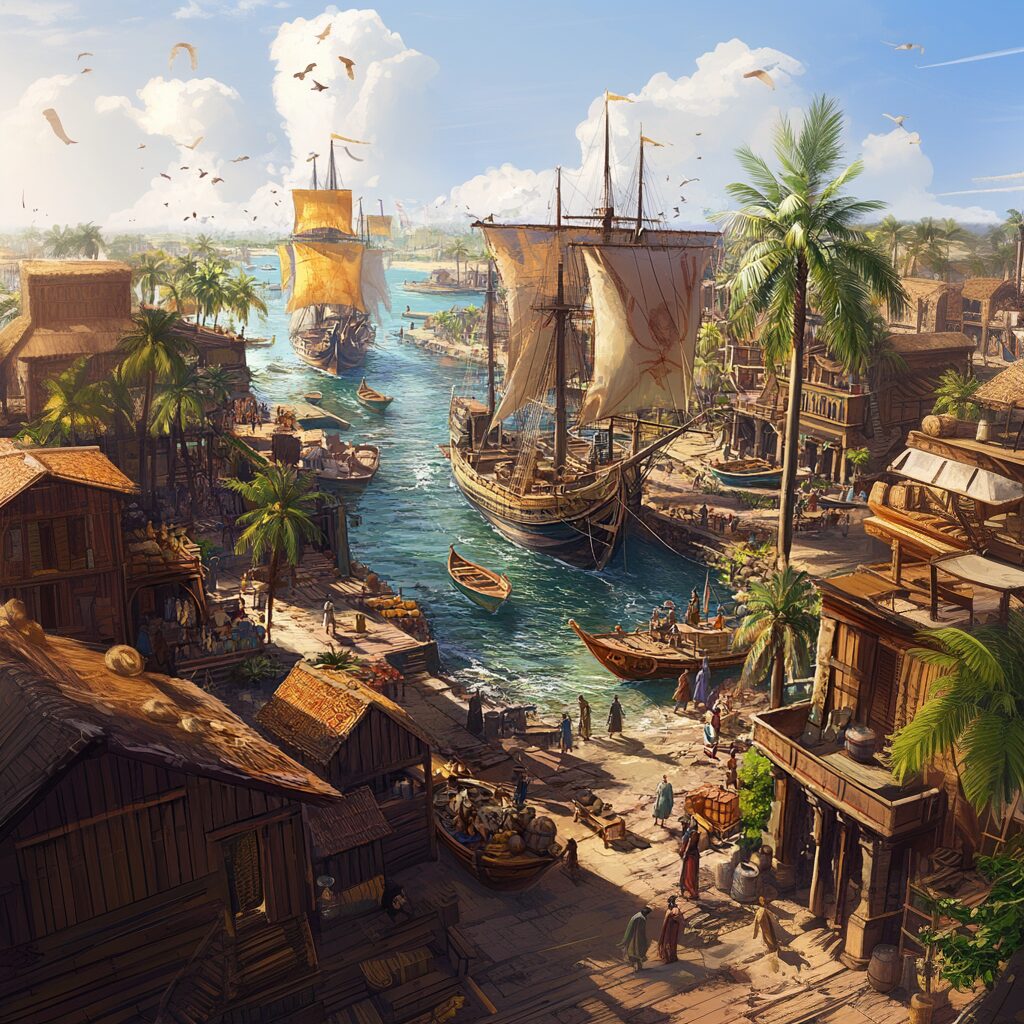
Tamilakam between two seas
Ancient Tamilakam included present-day Tamil Nadu and much of Kerala. The Chera, Chola and Pandya kingdoms controlled territories facing both the Arabian Sea and the Bay of Bengal.
Ports such as Muziris, Korkai, Puhar, Arikamedu and Alagankulam connected coastal trade with inland production centres. Pepper arrived from the Western Ghats, pearls from the Gulf of Mannar, beryl from the region around present-day Coimbatore, and beads and textiles from specialised manufacturing settlements.
Tamil merchants were not simply waiting for foreign ships. They participated in an interconnected commercial system extending from Roman Egypt to Southeast Asia.
Muziris: where gold was exchanged for pepper
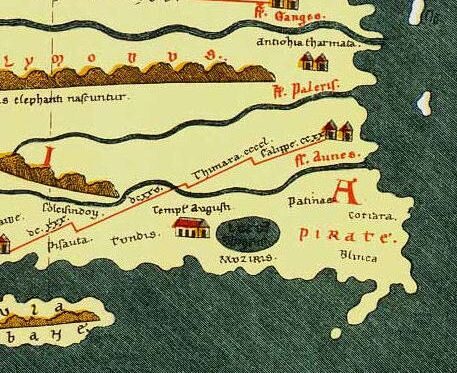
Muziris, or Muchiri, was an important Chera port on the Malabar Coast. The first-century Periplus of the Erythraean Sea says that large ships visited Muziris because of the quantity of pepper and other goods available there.
Tamil literature offers a remarkably similar account. Akananuru 149 describes well-built Yavana ships arriving at Muchiri with gold and leaving with pepper. “Yavana” was a broad term for people connected with the Greek-speaking western world; it should not always be translated simply as “Roman.”
The poem and the Periplus were written from different cultural perspectives, yet both identify Muziris as a major pepper-exporting port.
A surviving commercial contract
The Muziris Papyrus, written in Greek and preserved in Egypt, provides rare evidence of how this trade was financed. Dating to approximately the second century CE, it contains part of an agreement involving cargo transported from Muziris to Roman Egypt.
The document refers to commodities including pepper, ivory and Gangetic nard. It also records financial obligations connected with transport, loans and customs duties. Trade between southern India and Roman Egypt was therefore supported by contracts, investors, taxation and organised shipping—not merely by informal barter between visiting sailors.
The pepper that reached Egypt
At Berenike, a Roman port on Egypt’s Red Sea coast, archaeologists found approximately 7.5 kilograms of black pepper inside a pottery vessel. The jar came from a first-century CE context near the Temple of Serapis.
The pepper’s South Indian origin makes it one of the clearest physical links between the Malabar Coast and Roman Egypt. It confirms that the pepper described in Tamil poetry and Mediterranean trading texts actually completed the long journey across the Indian Ocean.
Berenike also contained Indian pottery, textiles, beads and Tamil-Brahmi writing, suggesting that at least some South Asian travellers reached the Egyptian coast themselves.
Arikamedu: Roman colony or Indian port?
Arikamedu, near present-day Puducherry, produced Mediterranean amphora fragments, Roman-period fine pottery, glass and evidence of extensive bead manufacturing. Early excavators interpreted it as a Roman trading station, possibly corresponding to the port called Poduke in classical geographical sources.
Later excavations showed that Arikamedu existed before and after the peak of Roman commerce. It was an Indian settlement and manufacturing centre participating in several regional and overseas networks—not a town proven to have been founded or governed by Rome.
Mediterranean merchants may have lived or stayed there, but imported objects alone cannot establish a permanent Roman colony.
Alagankulam and the eastern trade route
At Alagankulam near the mouth of the Vaigai River, excavators discovered hundreds of Mediterranean-related pottery fragments, including amphora pieces. The site also produced rouletted ware, beads, Tamil-Brahmi-inscribed pottery and Roman coins.
According to the Tamil Nadu Department of Archaeology, some coins belong to late Roman emperors such as Valentinian II. This is important because it suggests that western connections continued beyond the period normally associated with the height of Indo-Roman trade.
Alagankulam was also connected with Indian coastal networks. Scientific pottery analysis indicates that some ceramics arrived from other parts of India, showing that international trade depended upon extensive domestic exchange routes.
Puhar’s customs system
The Sangam poem Pattinappalai describes Puhar, or Kaveripattinam, as a port crowded with ships, warehouses and merchandise arriving from multiple regions. Customs officials collected duties and marked cleared goods with the Chola tiger emblem.
This detail reveals an organised administrative system behind the port. Goods were inspected, taxed, stored and marked before being released or exported. Maritime commerce therefore contributed not only to merchant wealth but also to royal revenue.
Tamil writing on the Egyptian coast
Pottery carrying Tamil-Brahmi inscriptions has been found at the Egyptian Red Sea ports of Berenike and Quseir al-Qadim. Berenike contained inscriptions in numerous languages, including Greek, Latin, South Arabian, Palmyrene Aramaic and Tamil-Brahmi.
This evidence is especially valuable because it reverses the usual direction of investigation. Roman objects found in India prove that goods travelled east; Tamil writing in Egypt demonstrates that South Asian people or their inscribed possessions travelled west.
Where does China enter the story?
Chinese silk reached western markets through complex networks involving Central Asia, Southeast Asia, India and the Roman world. Some silk or silk-related products may therefore have passed through Tamil ports during the Sangam period.
This does not prove that Chinese merchants were personally present in Tamilakam. Goods frequently changed owners several times before reaching their destination. A piece of Chinese silk could arrive through Southeast Asian, Central Asian or Indian intermediaries.
Chinese ceramics discovered at Tamil coastal sites provide stronger evidence for direct or closely connected trade in later centuries. Important finds from ports such as Periyapattinam generally belong to the early medieval and medieval periods, when Tamil maritime connections with China are much better documented.
Following the evidence in both directions
The trade route can be reconstructed through objects found at opposite ends of the Indian Ocean. Mediterranean amphorae, glass and coins reached Tamilakam. South Indian pepper, pottery, textiles and inscriptions reached Roman Egypt.
Three conclusions follow from that evidence:
- Roman-world trade with ancient Tamilakam is firmly established, although intermediaries handled some transactions.
- Chinese products probably reached Tamilakam, but this does not prove a resident Chinese merchant community during the Sangam period.
- Direct Tamil–Chinese maritime relations become much clearer during later Pallava and Chola centuries.
Indo Origins analysis
Ancient Tamilakam was not simply a remote supplier of exotic goods to Rome. Its ports, merchants, craftspeople and rulers formed an active part of the Indian Ocean economy. Tamil authorities collected customs duties, local industries manufactured goods for export, and South Asian travellers reached ports on the Red Sea.
The strongest evidence comes from connections that can be followed across different sources: Tamil poetry describes ships exchanging gold for pepper; a Greek papyrus records the financing of cargo from Muziris; and archaeologists in Egypt recovered South Indian pepper and Tamil writing.
The Chinese connection requires more caution. Chinese goods could travel farther than Chinese people, and most securely dated Chinese ceramics from Tamil coastal sites belong to later centuries. Ancient Tamilakam was globally connected—but each connection must be dated and demonstrated separately.
That evidence-based distinction is what makes the story more interesting than the simple claim that “Romans and Chinese lived in ancient Tamil country.”
Sources and further reading
- Tamil Nadu Department of Archaeology, Alagankulam excavation.
- Federico De Romanis, The Indo-Roman Pepper Trade and the Muziris Papyrus, Oxford University Press.
- Roberta Tomber, “Archaeology of Trade in the Western Indian Ocean, 300 BC–AD 700”.
- Vimala Begley, “Arikamedu Reconsidered”, American Journal of Archaeology.
- Chennai Customs, Sunkam: The Heritage of Chennai Customs.
- Sila Tripati et al., research on Chinese ceramic trade in India, Journal of Archaeological Science: Reports.