
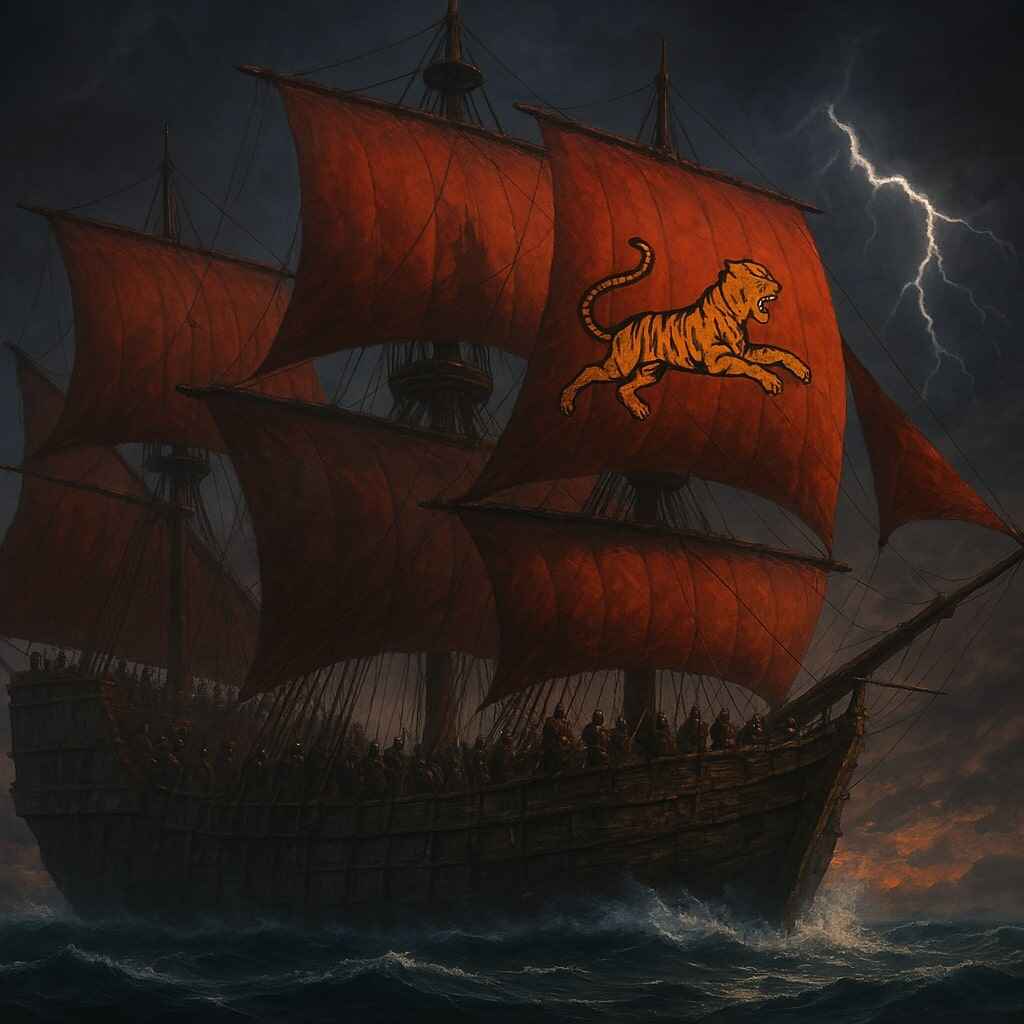
In approximately 1025 CE, Rajendra Chola I sent a fleet across the Bay of Bengal and attacked a chain of ports connected with Srivijaya. The expedition reached territories around present-day Malaysia, Sumatra and the approaches to the Strait of Malacca. It was one of medieval India’s most ambitious overseas military operations—but no surviving Chola source describes the fleet’s ships, dimensions or weapons in detail.
“Many ships into the middle of the rolling sea”
Rajendra’s inscriptions contain the Tamil expression alai-kadal naduvul pala-kalam selutti, usually translated as sending “many ships into the midst of the rolling sea.” The word kalam is the clearest contemporary Chola reference to the vessels involved, but it simply means a ship or large vessel. The inscription does not name different battleship classes or describe armoured hulls, battering rams or fixed numbers of marines.
Thirteen places named in a victory inscription
The inscription claims that Rajendra’s forces captured Sangrama Vijayottungavarman, the ruler of Kadaram, along with his treasures and the jewelled Vidyadhara Torana. It names thirteen places connected with the campaign: Srivijaya, Pannai, Malaiyur, Mayirudingam, Ilangasokam, Mapappalam, Mevilimbangam, Valaippanduru, Takkolam, Madamalingam, Ilamuridesam, Nakkavaram and Kadaram.
Several identifications remain debated, but Kadaram is generally associated with Kedah in Malaysia, Pannai with northeastern Sumatra and Ilamuridesam with Lamuri in northern Sumatra. Nakkavaram is often connected with the Nicobar Islands. Rather than one decisive sea battle, the inscription suggests a coordinated series of attacks across a wide maritime network.
It was probably a raid, not a permanent conquest
There is little evidence that the Cholas attempted to govern Sumatra or the Malay Peninsula after the campaign. No Chola provincial administration, tax system or permanent occupation has been securely identified there. Rajendra’s operation was probably designed to defeat important ports, capture wealth and demonstrate Chola power rather than annex the entire Srivijayan world.
The reason for the campaign is unknown. Control of trade with China, conflict over shipping routes and a political dispute with Srivijaya have all been proposed, but Rajendra’s inscriptions celebrate the victory without explaining why the fleet was sent.
The Cholas and Srivijaya had previously been partners
The attack is especially interesting because Chola–Srivijaya relations had earlier been cooperative. Around 1005 CE, the Srivijayan ruler Mara Vijayottungavarman supported the construction of the Chudamani Vihara, a Buddhist monastery at Nagapattinam on the Chola coast. Rajaraja I granted revenue from the village of Anaimangalam to support it, and Rajendra later confirmed the endowment.
Within approximately two decades, this diplomatic and religious relationship had turned into military conflict. The surviving records do not explain what caused the change.
A Tamil inscription discovered in Sumatra
A Tamil inscription dated to 1088 CE was discovered at Lobu Tua near Barus on Sumatra’s western coast. It records the activities of the Disai Ayirattu Ainnurruvar—the “Five Hundred of the Thousand Directions”—an influential South Indian merchant organisation.
Barus was internationally valued for camphor, benzoin and forest products. The inscription discusses commercial dues and trading privileges, showing that Tamil merchants maintained an organised presence in Sumatra 63 years after Rajendra’s expedition. This does not prove that the Chola government ruled Barus, but it demonstrates the depth of Tamil commercial involvement in the region.
An inscription may name a coastal commander
A Sirkazhi inscription dated to 1187 mentions an officer called Araiyan Kadalkolamitantaan, also known as Amarakon Pallavaraiyan. He is associated with the term karaippadaiyilar, which has been interpreted as a military force stationed along the coast.
This is one of the rare possible references to specialised coastal military organisation under the later Cholas. Even here, the record does not provide a fleet structure comparable to a modern navy.
The mystery of Kandalur Salai
Rajaraja I repeatedly used the title Kandalur-salai kalam-arutta. One interpretation is that he “destroyed the ships at Kandalur Salai,” possibly referring to an attack on a Chera harbour or naval establishment. Other historians argue that kalam could mean a feeding vessel or institutional privilege and that the phrase concerns the regulation of a religious or military institution.
The disagreement demonstrates why individual Tamil words cannot safely be transformed into elaborate descriptions of naval battles without considering their inscriptional context.
Where did the popular ship names come from?
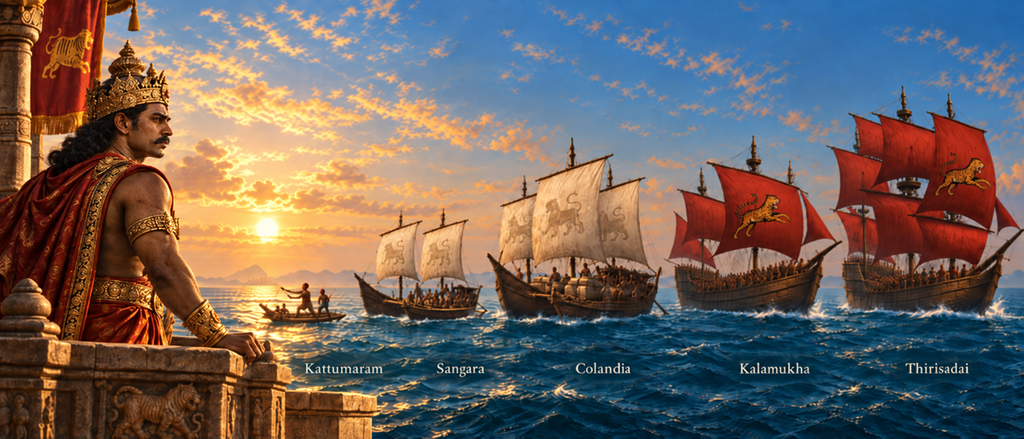
Sangara and colandia appear in the first-century Periplus of the Erythraean Sea, written about 900 years before Rajendra’s campaign. They cannot be identified automatically as Chola ships. Kattumaram is a genuine Tamil term for a raft formed from bound logs, but it is not documented as an imperial Chola warship class.
More dramatic names such as thirisadai and claims about ships carrying exactly 400 marines cannot be traced to reliable Chola inscriptions. The surviving evidence does not allow historians to reconstruct an official list of Chola battleships.
Indo Origins analysis
The Cholas did not need imaginary armoured battleships to make their naval achievement impressive. Moving an army across the Bay of Bengal required ships, crews, provisions, navigational knowledge and coordination with ports separated by thousands of kilometres. Rajendra’s forces then struck numerous targets spread across one of the world’s most important maritime corridors.
What remains unknown is equally fascinating: where the fleet assembled, how many ships sailed, what they looked like, whether battles occurred at sea or after landing, and how the troops returned. The inscriptions prove the expedition happened while leaving the fleet itself as one of the great unanswered questions of Chola history.
Best book for this subject
The strongest specialist resource is:
Hermann Kulke, K. Kesavapany and Vijay Sakhuja, editors, Nagapattinam to Suvarnadwipa: Reflections on the Chola Naval Expeditions to Southeast Asia, ISEAS Publishing.
The most useful chapters are:
- “The Military Campaigns of Rajendra Chola and the Chola–Srivijaya–China Triangle”
- “Rajendra Chola I’s Naval Expedition to Southeast Asia: A Nautical Perspective”
- Y. Subbarayalu’s “A Note on the Navy of the Chola State”