

A sword stood upright beside one grave. Its copper sheath had been placed horizontally across a row of pottery. Nearby, archaeologists uncovered decorated coffins, shields, headgear and three copper-covered vehicles.
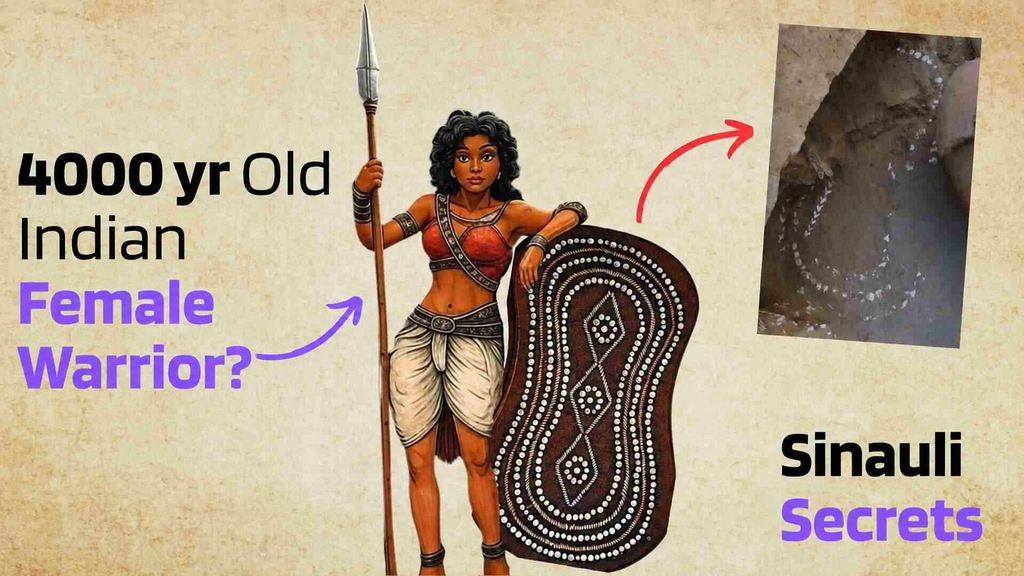
Women were also buried at Sinauli.
Together, these discoveries inspired a fascinating possibility: did women fight as warriors in northern India approximately 4,000 years ago? The answer is not as simple as the headlines suggest.
A cemetery discovered by accident
Sinauli is located in the Upper Ganga–Yamuna Doab in the Baghpat district of Uttar Pradesh. The site attracted archaeological attention after agricultural work exposed ancient pottery and human remains.
Excavations conducted by the Archaeological Survey of India in 2005–06 uncovered approximately 116 burials. A second excavation, conducted nearby in 2018, revealed eight elite graves containing wooden coffins, copper objects and three full-sized wheeled vehicles.

The two excavations revealed different parts of the ancient burial landscape. Objects discovered in one grave should therefore not be combined with people or artifacts found in another.
A 4,000-year-old culture
A peer-reviewed study published in Radiocarbon places the excavated culture at approximately 4000 years before present, or around 2000 BCE. The cemetery is associated with the Ochre-Coloured Pottery and Copper Hoard cultural complex of the Ganga–Yamuna Doab.
This places Sinauli broadly alongside the Late Indus period. It does not, however, establish the language, ancestry or ethnic identity of the people buried there.
What was found with the identified woman?
The 2005–06 excavation report describes Burial 1 as a primary female burial. She wore copper bangles on both wrists and a band composed of small steatite beads. A terracotta bead discovered near her waist may once have formed part of a waistband.
These objects reveal something about her clothing and personal identity. But the published excavation report does not describe this woman as being buried with a full-sized sword, shield or vehicle.
This distinction matters because popular accounts sometimes combine objects from separate graves, creating the impression that one woman was found with every major military artifact discovered at Sinauli.
The mysterious upright sword
One of the cemetery’s most revealing discoveries came from Burial 14. Archaeologists found an antenna sword standing upright on the northern side of the grave, while its copper sheath lay horizontally across the pottery offerings.
The burial contained no skeleton. It was a symbolic grave, possibly created to commemorate someone whose body was unavailable or buried elsewhere. Since there were no human remains, the sword cannot be assigned to either a man or a woman.
Its significance lies elsewhere: it provided the first excavated association between a Copper Hoard antenna sword and a cemetery connected by the excavators with the Late Harappan cultural world.
The elite graves discovered in 2018
The 2018 excavation uncovered a smaller and more elaborate group of burials approximately 100 metres from the earlier cemetery. Several contained wooden coffins, and three were associated with full-sized wheeled vehicles.
The most elaborate coffin stood on legs and had been covered with copper sheets fastened to its wooden structure. Eight anthropomorphic figures decorated its lid. The grave also contained headgear, a sword, shield, pottery, beads and other objects suggesting exceptional social status.
These discoveries led the excavators to describe the site as a royal cemetery belonging to a warrior elite.
Chariots or ceremonial carts?
The three vehicles were constructed largely from wood, which had decayed. Copper coverings preserved the shapes of their solid wheels, axles, poles and decorative elements. The excavators identified them as chariots and suggested that they were used in warfare.
Other archaeologists have questioned that interpretation. Chariots designed for speed normally have lightweight spoked wheels, while Sinauli’s vehicles had solid wheels. No horses were found buried with them, and no securely identified horse harness has demonstrated what animals pulled them.
They may have been war vehicles, elite transport or ceremonial carts. Until evidence of their draft animals and practical use is recovered, “copper-clad vehicles” remains the most neutral description.
Does a weapon make someone a warrior?
Weapons in graves can indicate military identity, but they can also symbolise authority, family status, ritual power or membership in an elite group. Even a sword found beside an identified individual does not automatically prove that the person used it in combat.
A stronger warrior identification would combine several kinds of evidence: a securely sexed skeleton, functional weapons in the same undisturbed grave, healed combat injuries or activity-related changes in the bones. Ancient DNA could also confirm biological sex when the skeleton is incomplete or poorly preserved.
No published study has yet brought all of that evidence together for a Sinauli woman.
What about the miniature copper dagger?
Some accounts describe a female skeleton accompanied by a miniature copper dagger or implement. If its association is confirmed in the complete excavation record, it would be relevant evidence that military symbolism extended to at least one female burial.
Its small size nevertheless raises questions. Was it a functional weapon, a ritual object, a model made for burial or an emblem of inherited status? A grave inventory alone cannot answer that question.
Were women important at Sinauli?
Yes. Women received formal burials and personal ornaments within the cemetery. Their inclusion shows that they were recognised participants in the community’s funerary system.
What remains unknown is whether particular women exercised military command, fought in battle or inherited symbols associated with warrior families. Sinauli leaves that possibility open without proving it.
A society revealed through its dead
The cemetery contained complete burials, secondary burials and symbolic graves without bodies. This variety indicates that burial at Sinauli was governed by complex ideas about memory, identity and the afterlife.
The copper-covered coffins, decorated vehicles and carefully arranged weapons also required skilled craftspeople and access to considerable resources. Sinauli was not an ordinary village graveyard. It was connected to a society capable of supporting specialised metalworking, woodworking and elaborate funerary ceremonies.
What Sinauli cannot tell us yet
Sinauli is sometimes drawn into debates about Aryan migration, Vedic culture and the origin of chariot technology. The archaeological discoveries alone cannot resolve these questions.
Radiocarbon dating determines when the burials were created. It does not reveal the language spoken by the people, their complete ancestry or the stories they told about themselves. Those questions require archaeological comparison, linguistic research, ancient DNA and additional securely dated sites.
The evidence still waiting to be published
Important information remains unavailable in a comprehensive grave-by-grave excavation monograph. We still need to know precisely which weapons belonged to which skeletons, how each individual’s sex was determined, whether skeletal trauma was present and whether DNA or mobility studies were successful.
These missing details are not reasons to dismiss Sinauli. They are the reason the site remains so compelling.
Indo Origins analysis
Sinauli has not yet proved the existence of an organised class of female warriors. The records establish that women were buried there and that weapons, shields and vehicles played important roles within the cemetery. They do not securely connect the most spectacular military objects with an identified woman.
The responsible conclusion is also the most intriguing: Sinauli belonged to a highly organised and possibly martial society in which women occupied recognised positions, but the precise nature of those positions remains unknown. A future osteological, DNA or grave-context study could still transform the female-warrior possibility into something much stronger.
For now, Sinauli offers evidence—not a finished story.
Sources and further reading
- Shalini Sharma et al., “Royal Burials and Chariots from Sinauli: Radiocarbon Dating and Isotopic Analysis Based Inferences”, Radiocarbon, 2024.
- D. V. Sharma, K. C. Nauriyal and V. N. Prabhakar, “Excavations at Sanauli 2005–06: A Harappan Necropolis in the Upper Ganga–Yamuna Doab”, Puratattva 36.
- S. K. Manjul and Arvin Manjul, “Recent Excavation at Sanauli, District Baghpat, UP: A Landmark of Indian Archaeology”, Puratattva 48, pp. 220–225.
- Asko Parpola, “Royal ‘Chariot’ Burials of Sanauli and Archaeological Correlates of Prehistoric Indo-Iranian Languages”, Studia Orientalia Electronica.